MyInvois e-invoicing integration in Malaysia, built into your own system
We connect your POS, ERP, online shop or custom system to the LHDN MyInvois API, so invoices are signed, submitted and tracked without retyping. KLCube publishes an open-source MyInvois gateway, so your IT team can read the code before you decide.
Projects from RM30,000 We reply within 8 working hours.
What this service is, in plain words.
MyInvois e-invoicing integration connects your business system to the LHDN MyInvois API: sign-in tokens, digital signing, submission and status checks. It is for Malaysian companies whose POS, ERP or online shop must issue e-invoices. The mandate is phased, so confirm the dates that apply to you on hasil.gov.my. Projects start from RM30,000. KLCube’s open-source gateway shows how we build it.
- Line
- Automate
- Starts at
- RM30,000
- Reply
- Within 8 working hours
- Led by
- Zahid Aramai, the founder
Who this is for.
A POS or ERP that cannot issue e-invoices
Your system produces invoices, but not in the form MyInvois expects. We add the signing, submission and status handling around it, without replacing the system.
An online shop with many small B2C sales
The gateway supports the monthly consolidated invoice for B2C sales, as well as individual B2B and B2C submissions and drafts.
A group with several companies
Multi-company accounts and user roles keep each company’s invoices, credentials and staff apart inside one integration.
An IT team that wants an API, not a portal form
SDKs for TypeScript, Python, Java and C# let your developers call one REST interface instead of each learning the MyInvois details.
What you receive.
The integration with your system
Your POS, ERP or shop sends invoices to MyInvois and reads the result back, tested before go-live.
Digital signing
X.509 digital signing of each document with your organisation’s certificate.
Submission and status handling
Sign-in tokens, submission, status polling and LHDN rate limits handled for you.
Document types
Support for all nine MyInvois document types, including consolidated invoices and drafts.
Companies and roles
Accounts for more than one company, with users and roles.
An SDK in your language
TypeScript, Python, Java or C#, for the developers who will maintain the connection.
Documentation and handover
How the integration works, how to read a failed submission, and the source code as set out in the proposal.
How the project runs.
- Brief Your brief
Which system issues invoices today, which document types you need, who signs, and the dates that apply to you, which you confirm on hasil.gov.my.
- Blueprint and design 20%
How the data moves from your system to MyInvois and back, where the certificate is kept and who can see which company.
- Core development 30%
The connection, signing and submission, built on our open-source gateway where it fits and written fresh where it does not.
- Feature completion 30%
Consolidated invoices, drafts, error handling, retries and the roles your companies need.
- UAT and go-live 20%
Your finance team tests with real invoices before go-live. We fix what they find, then release.
- Support After go-live
Support after go-live as set out in the proposal. LHDN changes its API over time, so we agree who tracks the changes.
Four payments follow the route: 20%, 30%, 30% and 20%. Work outside the agreed scope is quoted and approved in writing first.
The open-source gateway
The MyInvois Middleware Gateway is an open-source REST gateway between a business system and the LHDN MyInvois API, published under the MIT licence. It is unofficial and not affiliated with LHDN. Its code is public, so your IT team can read what it does.
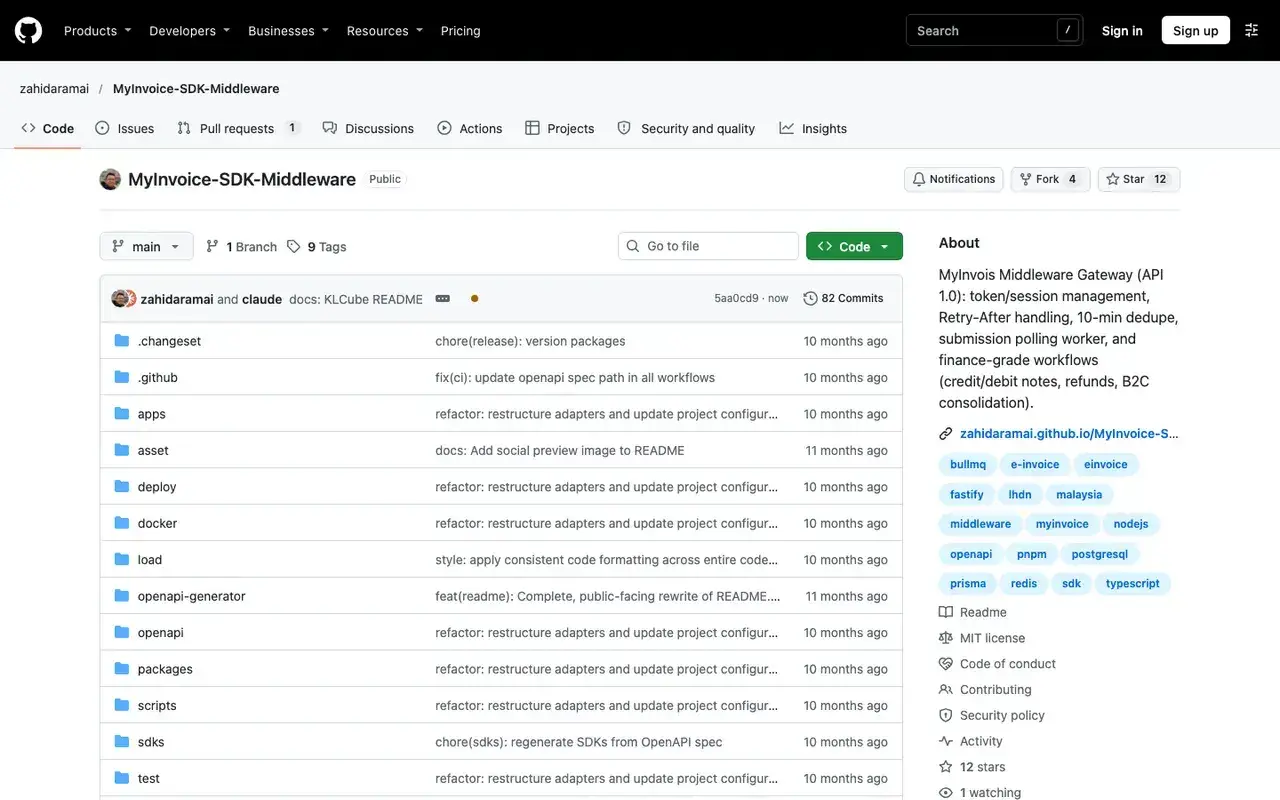
MyInvois Middleware Gateway
Consolidated B2C, B2B and B2C submissions, plus drafts.
Read the case studyThe gateway has nine document types, X.509 digital signing, multi-company accounts and SDKs for TypeScript, Python, Java and C#. It is an independent project: unofficial, and not affiliated with LHDN.
What it costs and what moves the price.
Projects from RM30,000. The project estimator gives a planning range.
The price moves with the number of systems to connect, the document types you need, the number of companies, how invoices reach the gateway, where it is hosted and the volume you expect. Whether the open-source gateway can be the base is decided in the blueprint, and the proposal says how that changes the work.
For smaller websites, see the founder’s freelance practice: zahidaramai.com
What is not included.
- Your MyInvois registration and taxpayer credentials, which belong to your organisation.
- The digital certificate itself and its fee, which is issued to your organisation.
- Tax, accounting and compliance advice, including which dates and thresholds apply to you. Confirm these on hasil.gov.my or with your tax adviser.
- Changes that your accounting software vendor must make in its own product.
- Hosting fees and third-party licences, unless the proposal includes them.
- Any statement that LHDN approves or endorses the work. KLCube is not affiliated with LHDN.
Answers for procurement.
For the person who has to justify the choice to someone above them.
- Who owns the source code?
Ownership of the integration code is set out in the proposal and the agreement. The open-source gateway stays under its MIT licence, and anyone may use it.
- How is payment staged?
Projects above RM30,000 are paid in four stages: 20% at blueprint and design, 30% at core development, 30% at feature completion and 20% at UAT and go-live. Proposals are valid for 30 days. Out-of-scope work is quoted and approved in writing first.
- Do you accept a purchase order?
Yes. Government and GLC clients use the same four stages, and we accept a purchase order.
- How is invoice data protected?
Invoices hold business and personal data. We follow the PDPA, limit access to what the work needs and set out in the proposal where the data is processed and stored. KLCube holds no security certification and does not claim one.
- Who hosts the gateway and who supports it?
Hosting is agreed in the proposal, in an account in your organisation’s name or one we arrange, with the cost listed separately. Support terms are also set out in the proposal. A standard enquiry gets a reply within 8 working hours.
Questions buyers ask.
When must we start issuing e-invoices?
The MyInvois mandate is phased, and the dates that apply depend on your business. We state no date here because dates change. Check hasil.gov.my, then give us the date that applies to you so the plan can start from it.
Is the gateway official or approved by LHDN?
No. It is unofficial and not affiliated with LHDN. It is an independent open-source project that works with the MyInvois API.
Can we use the gateway without hiring you?
Yes. It is free under the MIT licence, and the code is at github.com/zahidaramai/MyInvoice-SDK-Middleware. Hire us when you want it integrated, tested and supported.
Can it handle consolidated invoices for retail sales?
Yes. The gateway supports the consolidated invoice for B2C sales, as well as B2B and B2C submissions and drafts.
Will it work with our accounting software?
That depends on what the software lets other systems read and write. We check this in the brief and say plainly if the software must change first.
What does it cost to start?
Projects start from RM30,000. Smaller work is taken by zahidaramai.com, which starts from RM2,500.
Services that go with this one.
- Platforms and custom softwarePlatforms, SaaS, ERP and POS built around how you work.
- E-commerce and order hubsOnline stores, and one order hub for your store and Shopee.
- Web developmentWeb applications, portals and integrations behind the website.
- Maintenance and supportUpdates, fixes and care after launch, under its own agreement.
Start a MyInvois brief
Tell us which system issues your invoices. We reply within 8 working hours.
What happens next
- You send a brief, or a message on WhatsApp.
- We reply within 8 working hours with questions or a time to talk.
- You receive a written proposal with scope, milestones and price. It is valid for 30 days.